
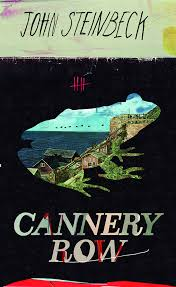
 Cannery Row by John Steinbeck (Penquin, 2012)
The book, published in 1945, is set during the 30’s in Monterey, California. Most of it takes place on a street lined with sardine canneries that is known as Cannery Row. The story revolves around the people living there: Doc, a marine biologist, Mack, the leader of a group of homeless bums, Lee Chong, the local grocer, Dora, the whorehouse madam, etc. Not much of a plot (Mack has the idea that they (the bums) should give Doc a party). This doesn’t sound enticing, but Mr Steinbeck created a remarkable book with remarkable characters. All are flawed – they can often appear even ridiculous. (Even Doc, who is by far the most educated/intelligent/cultured of the Cannery Row characters.) The characters have no real aspirations, they live day to day – in a sense all the characters are “bums”. (Even Doc: I noted that when the party (which took place without him there) resulted in at least $300 damage, Doc had to get a loan to replace the damaged items – indicated to me that he wasn’t saving money, that is, not looking ahead.) But the characters live – it’s no wonder that after the book’s publication many people visited Monterey in order to walk down “Cannery Row”. Mr Steinbeck visited the area in 1960 (described in “Travels with Charley”). Bad mistake! – it was by then a tourist attraction and much altered – author upset and made a hasty getaway.
I have read that the Nobel committee awarded him the big prize mostly on the strength of his “Grapes of Wrath”. But in my opinion, “Cannery Row” is the more artistic and complex. “Grapes” hits you in the face with its powerful statement against social injustice and suffering, but “Cannery” stays with you longer after reading it. The author is so clever and I’ll tell you why: lots of comic scenes in the book (the frog hunt, for example); Mack and the boys in the “Palace Flophouse” appear to be a bunch of happy-go-lucky down-and-outs; and the book has a fairly happy heartwarming ending. But some time after I read the last page and put the book down, I say “Wait, just a minute…” because a delayed reaction hits you of two underlying themes: sadness and death.
- underlying sadness
Only once in the book does Mack actually tell the truth about himself (after Doc in anger busts him in the face for causing all the damage): “It don’t do no good to say I’m sorry. I been sorry all my life…. I was glad when you hit me. II thought to myself – ‘Maybe this will teach me. Maybe I’ll remember this’ But, hell, I I won’t remember nothin’. I won’t learn nothin’ doc”. I could detail other examples (Doc, Frankie, Hazel, Gay). - death & violence
I have done a Wiki-read on it and noted it failed to mention the theme of death in the book. There were six human deaths (includes three suicides and a hallucination of a baby being killed), and a number of animal deaths (a rooster deliberately run over, a cat killing a mouse, & you can even count the numerous animals the Doc kills for specimens.)
This book (as well as Grapes of Wrath) reminds me of Charles Dickens, esp the vivid portrayal of popular speech. I could see Steinbeck going around with a notebook, as did Dickens, jotting down fragments of overheard conversation.
 deescommonplacebook.com